First Stability Assessment in the Italian Demonstration Case

The work carried out by our partner, Fraunhofer EMI, over the past few months has produced initial results for assessing frequency stability in the Italian Demonstration case within the eFORT project. To this end, a series of dynamic disruption simulations were performed, and the corresponding results were evaluated in terms of frequency stability. All simulations and analysis were performed using the PyDyn-EMI simulation program developed in-house by Fraunhofer EMI. 

The underlying grid is a section of the 20kV distribution grid in the region around Sarentino. Approximately ten thousand consumers are connected to this section of the grid, which are supplied via the transmission grid during normal operation. In the event of an imminent failure of the transmission grid, the distribution grid is to be operated as an island grid with the help of local renewable energy sources (RES) mainly hydro, biogas and photovoltaic generators. 

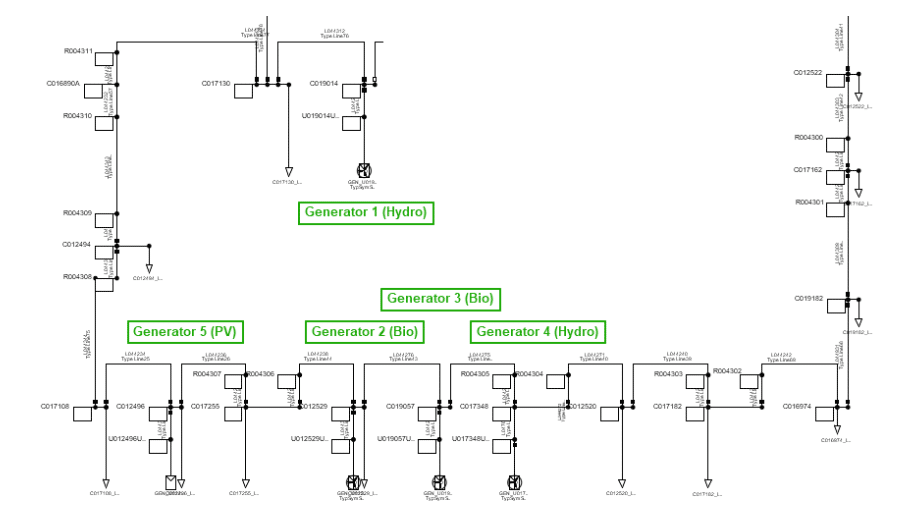
Groundwork by the other effort partners, Selta DP and LINKS, focused on the optimal segmentation of the distribution grid to form viable grid islands, taking online system conditions into account. Based on these results, one of the grid islands found was finally investigated from a dynamic point of view. Figure 1 shows the topology of a section of the distribution grid under consideration, which can be operated in isolation. It contains four conventional generators (hydro and biomass) and a PV system. 

Figure 1: Island topology including generators. 

A task that precedes the frequency of stability assessment is the dynamic modeling of the connected generators, including their control and regulation components. This was carried out in the PyDyn-EMI simulation program. 

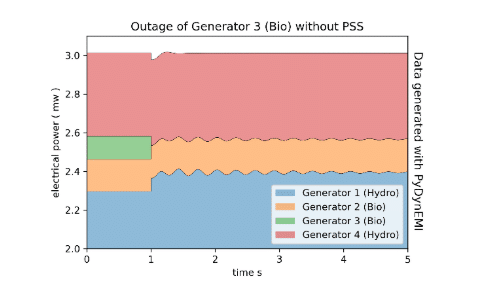
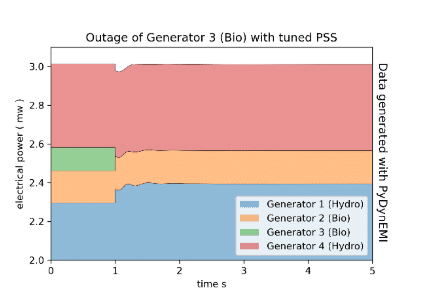
In general, if there are several generators in the island grid and the grid is weakly coupled, power oscillations can occur between the generators. Initial simulations using standard models for the generators showed precisely such oscillations as shown in Figure 2. The implementation and targeted parameter setting of so-called power system stabilizers in each of the power plants effectively eliminated the oscillations (compare Figure 3), allowing the actual analysis task, namely the frequency stability assessment. 

Figure 2: Stacked generator power curves without PSS. 
Figure 3: Stacked generator power curves with tuned PSS. 

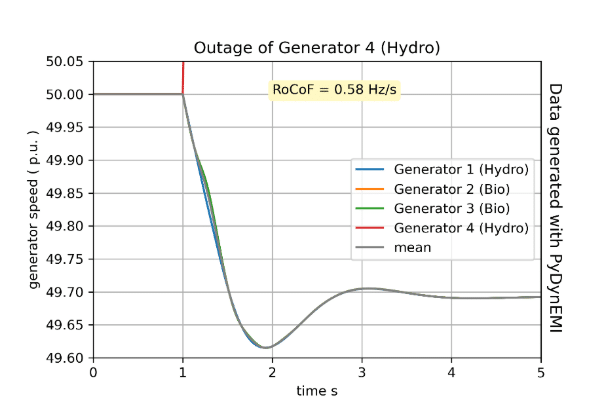
Another special feature of island grids is the typically high proportion of generators with low or even no inertia, which can lead to a reduction in frequency stability. This makes the investigation of frequency stability an increasingly important task. A central indicator in the context of evaluating frequency stability is the rate of change of frequency (rocof) immediately after a sudden active power imbalance occurs. Such imbalances can occur, for example, due to load steps or the outage of generators. Figure 4 shows the simulated frequency curve after the hypothetical failure of a hydroelectric power plant. The value in this example of 0.58 Hz/s is within a moderate range, based on typical limits for transmission grids. These are typically in the range of 1-2 Hz/s. 

Figure 4: Frequency curves after the outage of generator 4. 

Further simulations will be carried out using more realistic generator models and underlying operating conditions to enable comprehensive and reliable assessments of the frequency stability of the islands. 


Contact us

contact@efort-project.eu 

Follow us on:

Not Just Technology: The Human Side of Innovation Success – Join the Social Innovation Workshop at ENLIT Europe 2025

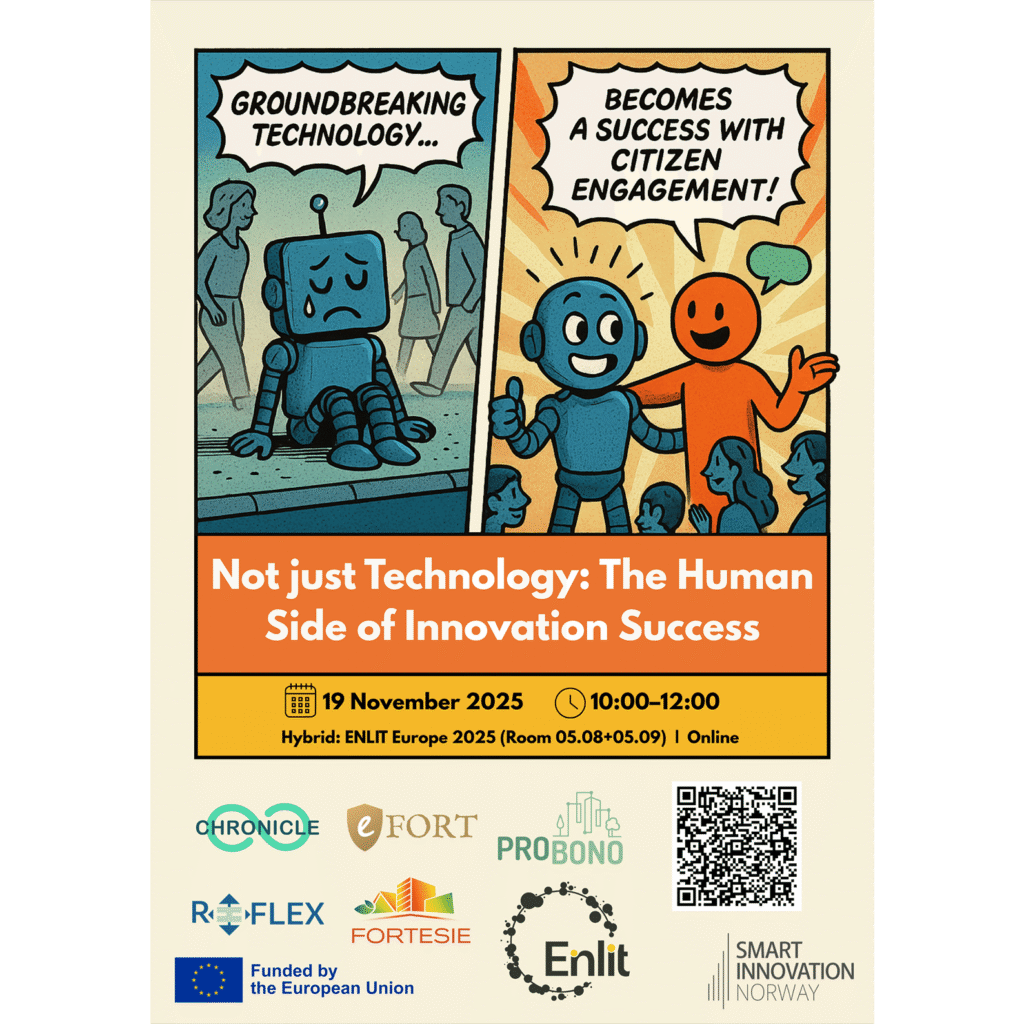
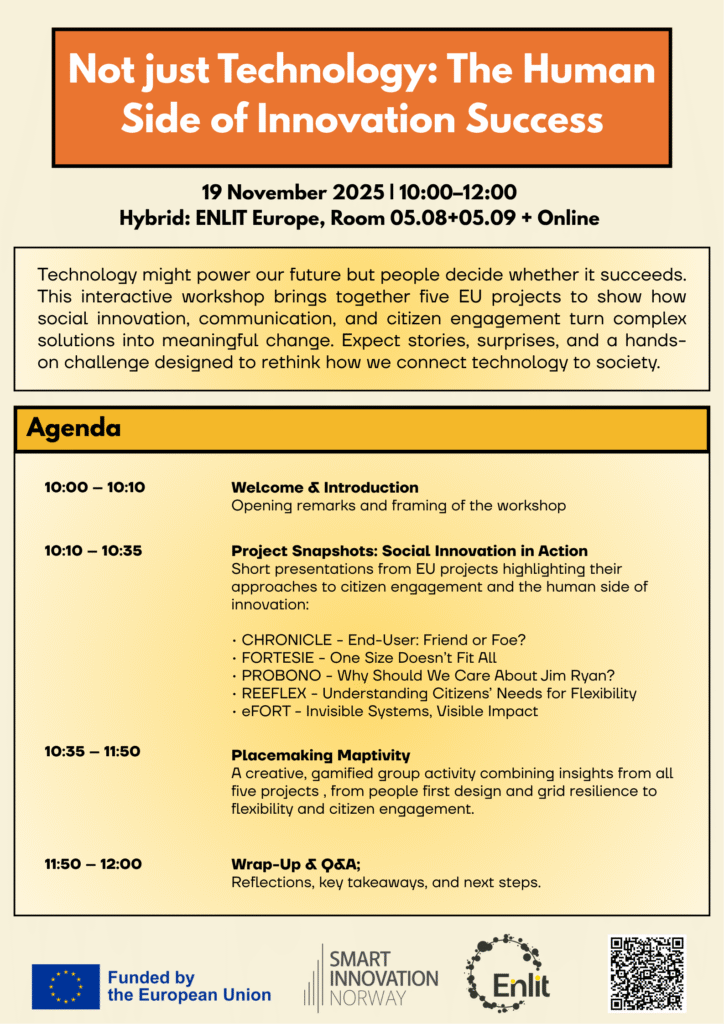
Five Horizon projects, CHRONICLE, PROBONO, REEFLEX, eFORT, and FORTESIE, will come together at ENLIT Europe 2025 in Bilbao to host a hybrid Social Innovation Workshop titled “Not Just Technology: The Human Side of Innovation Success.” The session will explore how inclusion, trust, and citizen engagement define whether innovation succeeds – both onsite and online.

Introduction

Behind every smart grid, connected building, or renewable system lies a simple truth: technology alone doesn’t drive change – people do!

As Europe accelerates its green and digital transition, the role of social innovation has become more critical than ever. Without public trust, citizen participation, and inclusive design, even the most advanced technologies risk falling short of their potential.

Recognising this, five Horizon Europe projects, CHRONICLE, PROBONO, REEFLEX, eFORT, and FORTESIE, are joining forces at ENLIT Europe 2025 in Bilbao to host a joint Social Innovation Workshop titled “Not Just Technology: The Human Side of Innovation Success.”

Organised by Smart Innovation Norway, the event will take place on 19 November 2025 (10:00–12:00, Room 05.08+05.09, and online via Microsoft Teams). It invites researchers, industry experts, policymakers, and citizens to experience how human factors,  from trust and fairness to communication and behaviour, determine whether innovation truly works in real life.

Objective & Approach

The Social Innovation Workshop aims to bridge the gap between technological excellence and social acceptance. Designed as a truly hybrid experience, it ensures equal participation for both onsite and online audiences.

Instead of traditional slides or lectures, the workshop uses interactive storytelling and dialogue. Participants will explore real-life dilemmas inspired by the five Horizon projects, touching on topics such as data ethics, inclusivity, workforce adaptation, and public trust.

One of the key interactive elements, inspired by Placemaking Maptivity, will transform technical project results into accessible, human-centred scenarios. Participants will discuss and “map” these cases according to social impact and feasibility, learning how innovation decisions affect communities, equity, and resilience.

Whether sitting in Bilbao or joining virtually, every participant will play a role in shaping the discussion, sharing insights, reflecting on values, and contributing to a shared vision of people-centred innovation.

What to Expect from the Workshop

  • CHRONICLE – End-User: Friend or Foe?: CHRONICLE will challenge the assumption that digitalisation automatically improves user experience. By examining how occupants interact with smart building and energy systems, the project highlights that real behaviour often defies design expectations. Participants will explore how feedback loops, empathy, and co-creation can make digital transformation more meaningful and accepted
  • FORTESIE – One Size Doesn’t Fit All: FORTESIE will explore how energy renovation and efficiency measures can only succeed when they reflect social diversity. Through examples from local communities, the project demonstrates that engagement is not a one-size-fits-all process, it must be tailored, inclusive, and culturally relevant. The discussion will focus on how to motivate participation across generations and socio-economic groups.
  • PROBONO – Why Should We Care About Jim Ryan?: PROBONO will bring storytelling to the forefront with the case of Jim Ryan, a social housing manager in Dublin. His everyday challenges managing buildings and residents show how innovation must account for maintenance realities, community relationships, and lived experience. The story reminds participants that sustainability is not just about technology, it’s about the people maintaining it.
  • REEFLEX – Understanding Citizens’ Needs for Flexibility: REEFLEX will share lessons from citizen engagement around flexibility markets and smart energy systems. Participants will discuss how perceptions of fairness, clarity, and local benefit shape public trust in new energy models. The project’s findings reveal that flexibility is not just technical, it’s deeply social, requiring transparency and cooperation.
  • eFORT – Invisible Systems, Visible Impact: eFORT will take participants into the unseen world of cybersecurity and grid resilience. The session will highlight how human understanding is crucial for the success of even the most advanced technical systems. Participants will explore how clear communication, transparency, and stakeholder engagement can turn complex resilience measures into something relatable and trusted by citizens.

Together, these five perspectives will demonstrate that innovation success depends not only on what we build but on how we involve people in building it.

Mapping Innovation Together: An Interactive Session with Placemaking Maptivity

The interactive session will also feature Placemaking Maptivity, a collaborative tool originally developed within the PROBONO project. Designed to support sustainable urban planning and citizen engagement, it enables participants to visualise how different social, spatial, and technical factors interact within real environments. Through guided mapping and dialogue, Maptivity helps identify opportunities, challenges, and trade-offs linked to innovation implementation. In this workshop, an extended version of the tool will include perspectives from all five projects and invite both onsite and online participants to collaborate in real time. Whether contributing from Bilbao or joining via Microsoft Teams, everyone will take part in shaping shared maps and reflections that connect innovation results to social impact, equity, and community acceptance.

Why Attend: In Person or Online

The Social Innovation Workshop offers a rare opportunity to explore the human side of Europe’s innovation landscape in a collaborative, creative format.

Participants will:

  • Experience a dynamic, discussion-based session connecting social innovation with real-world research.
  • Engage directly with five Horizon Europe projects addressing buildings, energy, and digital resilience.
  • Learn how behavioural insights, participatory design, and storytelling can strengthen technology adoption.
  • Network with peers at ENLIT and exchange reflections online in a live, hybrid dialogue.

Whether joining from Bilbao’s conference halls or tuning in from another country, all participants will contribute equally, sharing experiences, voting on scenarios, and shaping conclusions together.

Conclusion

The Social Innovation Workshop at ENLIT Europe 2025 will challenge the idea that innovation success is purely technical. It will show that inclusion, fairness, and trust are the real foundations of progress.

Join us in Bilbao or online for a hands-on, people-centred conversation on how Europe’s leading projects are redefining what innovation means – from grids and buildings to communities and lives.

To learn more about Social Innovation workshop and register: https://events.teams.microsoft.com/event/1ad5bb31-f1a6-47b4-a24c-8416680720c4@517c569c-dd6b-48c6-9d74-7e1db94fef56


Contact us

contact@efort-project.eu 

Follow us on:

From Threat Classification to Dynamic Risk Assessment: How eFORT is Building Resilient Power Systems  

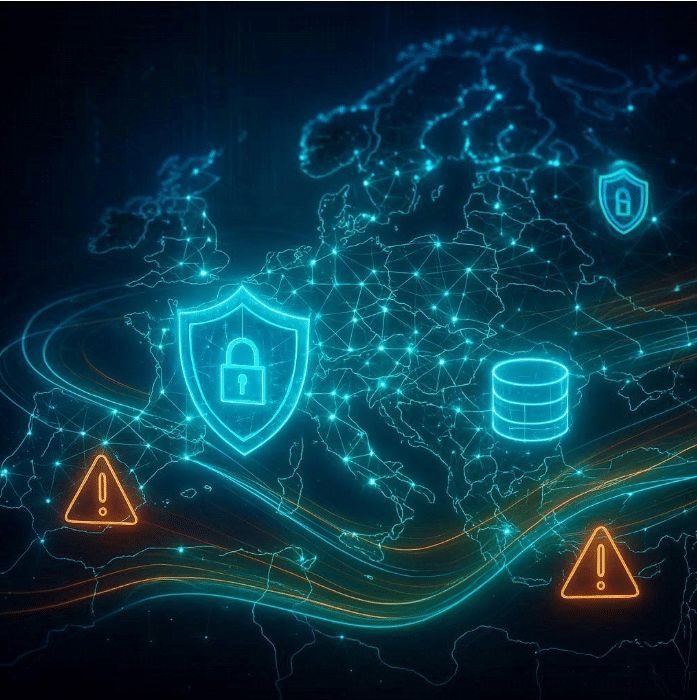
Europe’s power systems are facing increasing challenges from both natural and cyber threats. To protect the reliability of the electricity supply, it is not enough to react to crises, operators must anticipate, classify, and dynamically manage risks. 

Within the eFORT project, two key deliverables demonstrate how this process is unfolding: D2.1 (Characterization and Classification of EPES Threats) and D3.1 (Results of Dynamic Risk Assessment Tools). Together, they illustrate how systematic threat identification feeds into innovative tools for continuous resilience management. 

Mapping the Threat Landscape (D2.1) 

D2.1, led by our partner, HYPERTECH, focused on building a consolidated picture of the threats facing Electrical Power and Energy Systems (EPES). Drawing on literature reviews and expert surveys across Europe, the study identified vulnerabilities related to: 

  • Natural hazards such as windstorms and ice storms. 
  • Technological risks including operational faults and DER integration. 
  • Human-caused threats, with a growing emphasis on advanced cyber-attacks. 

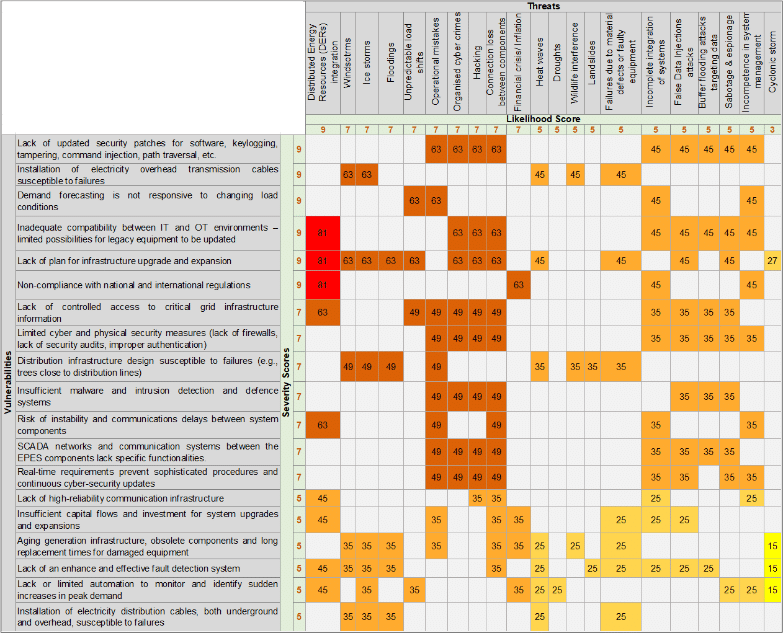
The results were prioritised using a risk scoring and heat map approach, which highlighted that cyber threats and distributed energy resources (DERs) are emerging as top concerns, alongside climate-related risks. 

Moving from Static to Dynamic Assessment (D3.1) 

Building on these insights, D3.1, led by our partners, RINA-C, FRAUNHOFER and COMILLAS, developed a Dynamic Risk Assessment (DRA) methodology. Where D2.1 provided a static classification of threats, D3.1 created the tools to monitor them continuously. 

The DRA integrates: 

  • Physical risk assessment modules (asset health and hazard exposure). 
  • Power network stability analysis (anticipating cascading failures). 
  • Cyber risk evaluations (including MaDIoT attacks via IoT devices). 

This transition from classification to dynamic monitoring ensures that vulnerabilities are not just identified once but are constantly reassessed in light of evolving threats

Without the foundational work of D2.1, the development of the DRA in D3.1 would lack context. The prioritization of threats in D2.1 directly informed the design of the risk modules in D3.1. For example: 

  • The prominence of cyber risks in D2.1 justified the inclusion of a dedicated cyberattack evaluation module in the DRA. 
  • The identification of DER-related vulnerabilities in D2.1 influenced the DRA’s focus on distributed generation and IoT-enabled devices. 
  • The risk heat maps from D2.1 provided a baseline against which dynamic risk monitoring could be benchmarked. 

Why This Matters for Resilience 

eFORT shows how research and innovation work hand in hand: 

  • Research (D2.1) maps the problem space. 
  • Innovation (D3.1) develops tools to address it in real time. 

Together, they provide a pathway for operators to prioritize resources, anticipate disruptions, and safeguard the continuity of Europe’s electricity supply

Conclusion 

The outcomes of D2.1 and D3.1 continue to inform other work packages in eFORT, from cascading effects analysis to self-healing grid development and standardization guidelines. Resilience measures are grounded in both empirical evidence and cutting-edge tools

The journey from characterizing threats to dynamically assessing them demonstrates eFORT’s holistic vision for grid resilience. Through this interconnected work, the project responds to today’s vulnerabilities and also anticipates tomorrow’s challenges, ensuring Europe’s energy systems remain reliable, secure, and adaptable. 


Contact us

contact@efort-project.eu 

Follow us on: