Flexibility and islanding in mountainous and remote areas

Flexibility and islanding in mountainous and remote areas
Sarentino Valley, Italy
Lead: SELTA-DPEDYNARINA-CLINKSFRAUNHOFER
Real-time decision support system for grid restorationControl scheme for islanding operation modeDigital twinInnovative services to exploit resources (ChatBot)

The Italian demo site is a distribution system located in Sarentino Valley in Northern Italy. The main DSO in the region is EDYNA, managing 8,608 km of the network (HV, MV and LV) and supplying electric power to 230,000 customers.
Because of the mountain morphology of the territory, a variety of hydroelectric plants are connected to the grid with 348 MW power installed on 616 MW of total MV and LV production. In addition, the EDYNA network supplies 50 sub-DSOs. The pilot demonstration is going to be performed in the MV and LV grid supplied by the HV/MV Sarentino substation.
The subject distribution system is characterized by an excess of power generation from hydroelectric power plants, particularly during the summer months. Most of the year, the power flows from the MV grid to the HV grid.
Subtended DSOs should also be able to manage their grid in island mode, through automatic primary/secondary frequency and voltage regulation of the local system.
The goal of the site is to demonstrate the developed grid islanding algorithms to avoid potential power outages and ensure the quality of the grid service.
Control scheme for islanding mode operation. Increasing the operational resilience during islanding operation mode using accurate field data collection and state estimator results.
Digital twins of the power system. Optimal data exchange using free libraries in software development in addition to communication standard chain for monitor and telecontrol scope.
Breakthrough in power system digitalisation. Performing a dispatching platform for DSO control centre in order to improve the observability of the grid, taking advantages from the comparison between traditional control schemes and artificial intelligent approaches.
Innovative services for resilient powers system through an optimal exploitation of available resource. Enabling of smart procedures for the remote control of the distributed energy resources based on single capabilities and grid constraints.
Integration of a grid ChatBot to facilitate consumer engagement. Design of user friendly human interface with the aim of assisting the DSO agents during tricky operation phases.

The Italian pilot successfully overcame the critical operational limitations of islanded grid restoration in the mountainous network of the Bolzano province. Overcoming past failures caused by generator instability under variable loads, poor load-step management, and the unpredictable output of distributed PV generation, the pilot validated a coordinated approach to autonomous islanded operation. Specifically, it replaced costly, polluting diesel generators with locally managed renewable energy sources (hydroelectric and PV) to supply isolated network sections during faults or maintenance. The pilot achieved a controlled, progressive re-energization process that carefully manages high inrush currents and connected loads, maintaining voltage and frequency stability, eliminating economic losses for offline hydro producers, and drastically cutting restoration times from hours to minutes while providing key insights to overcome current regulatory and legal barriers for sub-DSO islanding.
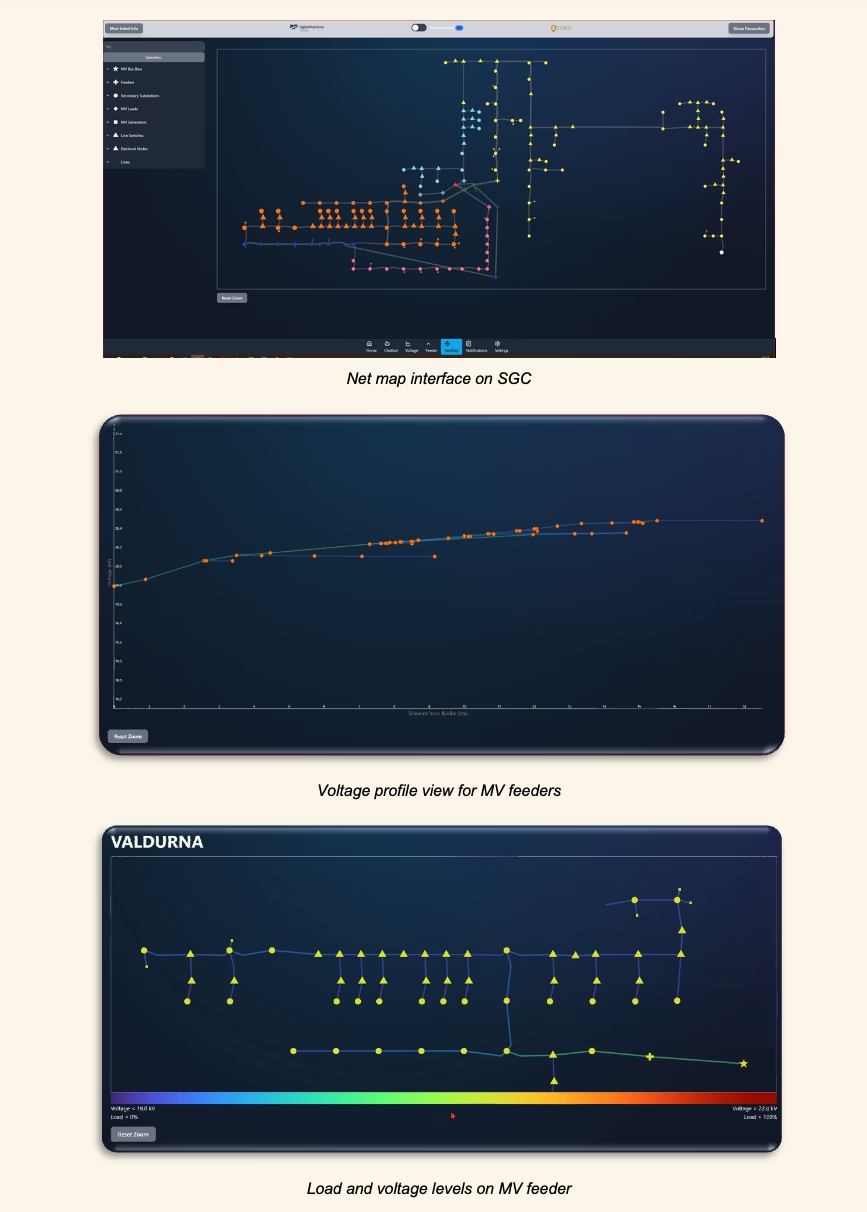
The Smart Grid Controller (SGC), integrated with DSO SCADA systems, enables a transition from reactive to proactive grid management through:
The implementation of the SGC within the eFORT framework has yielded three major improvements:
The pilot successfully validated four major use cases:
Distribution System Operators (DSOs), sub-DSOs, and local renewable energy producers benefit directly from these results.
The results significantly improve grid security and resilience by replacing vulnerable fossil-fuel dependencies with coordinated local hydro and PV assets during emergencies. The SGC enables real-time stability verification, automated load-step management, and immediate guided restoration during MV line faults, maintaining frequency and voltage stability even during isolated operations.
The solutions identified during the Italian Demo—ranging from AI control schemes to cybersecurity protocols—are designed for high replicability. They provide a blueprint for DSOs across Europe to manage critical scenarios and enhance the sustainability of distribution networks by prioritizing renewable resources over fossil-fuel backups.
Giacomo Dellacroce: giacomo.dellacroce@selta.com